Friday, October 26, 2012

STEM video

So I guess it has been awhile since I have posted, but after looking at my last post I realized I didn't post the STEM videos that were produced by Loft 49 films for NEA and AT&T.  So here they are.

The first video has three of the original 9 teachers involved in the first year of the STEM project with Ohio University.  We were the only 3 who stayed with the project all 3 years.  These are GREAT guys - it is so nice to get a chance to collaborate every summer.
http://www.youtube.com/watch?v=_Y5CYWVwBIk&list=UU7q6Q9HhBV2sesOrutfx8Hg&index=9&feature=plcp

The second video has a new member to the team.  http://www.youtube.com/watch?v=od6tQ-bPyRM&feature=relmfu

Keep doing what you love!

kim


Monday, April 23, 2012

2nd Semester - catching up with the activities

Things sure have been busy lately with school and activities! You would think after finishing my master's I would have more time, but I just added more to my list.

 February - Quality Matters Training was on my list. This is a program to show you how to improve your online or blended course. It is a great review of concepts that were taught in education coursework (aligning your curriculum) and newer things that involve technology. There are many courses in the Quality Matters Training - and it is all done online.

Right to Left:  Caleb, me, Jay

March - Wrapping up some of our STEM work with Ohio University and AT&T partners. Caleb Loft 49 Films in NY came to the school to do some more filming for the PSA that will air sometime this spring/summer. I was able to see the first PSA and WOW, hats off to Caleb, Jay (music) and the entire team for making Larry King (Warren High School), Troy Weaver (Vinton County High School), and myself look like stars!  LOL.
Opening Day at NSTA with NOAA in Indy


More March Madness! (mad like a scientist that is) - I attended the National Science Teacher's Association National Convention held in Indianapolis, IN. I always enjoy going to the NSTA to meet up with old friends, learn new things, and make new connections with people and organizations. This event I worked with another GREAT NOAA staff (and volunteers with the Teacher At Sea alumni). As usual I found new things on the NOAA Education site and another TAS told me about another great opportunity through the American Meteorological Society..... more on that later.  But first, if you teach grades 9-12, or honors 8th grade, then check out the new Coral Reef Ocean Acidification Program.  There are some great videos, powerpoints (that you can edit!), lessons, and more.  Click here

Sunday, October 30, 2011

STEM STEM

What is STEM STEM? Most people already know STEM - Science Technology Engineering and Mathematics, but STEM STEM is Second Tuesday Every Month Science Technology Engineering and Mathematics.

Most science teachers are already teaching science, technology, engineering, or mathematics in some form or another, but STEM STEM brings the application of these disciplines to the forefront of the lessons. With the push for more STEM teaching teachers are left to their own resources at times to do this. For some this is easy, for others they may not know where to start.

The majority of teachers feel very confident teaching in their expertise, but when asked to teach something outside their field (yes, it happens all the time) they are left in situations that may have them apprehensive to try new things in that discipline.

Knowing your discipline is very important, but what is also important is allowing students to ask questions and explore things that may be unfamiliar to you. Right now I have a group of students working on a solar water heater. Did I mention I was a biologist? I may not know everything needed to assist them in this project, but I know where to get help and I know the basic elements of scientific methodology.

STEM STEM has allowed me to invite teachers and students from local high schools to come and share independent inquiry with each other. This collaboration allows students and teachers to review project elements not just horizontally (student to student) but also vertically where teachers, students, mentors, professionals in the field all together discuss project elements, ideas, etc.

Two other components of STEM STEM are technology and teamwork. Technology is not just replacing blackboard notes with powerpoint slides, or spiral notebooks with laptops, but in STEM STEM we will use social networking. Teachers and students will be enrolled into an online course that will allow for collaboration and peer review in a format familiar with today's student. It is important for k-12 teachers to teach proper professional online conversation which differs from their personal 'facebook' type of social media. Already these lessons have had to be revisited as this is an ongoing process. Students may not know what is acceptable if they do not have a model to follow.

Each team will also document their projects from inception, design, testing, and evaluation. I have been able to acquire equipment that each teacher will need to successfully complete the technology portion. Teamwork is an ongoing lesson that students will learn. Teamwork in this case is dependent on each group member being a valuable 'cog in the wheel'.

Out of the 7 schools invited, we had response from 3. The first meeting was attended by my students, and teacher/student teams from 2 other local high schools. I am hoping this pilot program is successful so that we can continue it next year. I have had a couple of schools contact me since our first meeting that asked I invited them next year.

Sleepless in Seattle, no wonder, it is an amazing place!


Last month I had the most amazing trip to the Northwest. This wasn't a family vacation, but it some ways it felt like it.

NOAA asked me to be part of a symposium on Education Outreach at the American Fisheries Society Annual Meeting. It was very exciting to be asked to join fellow teachers, professionals from NOAA, and biologists in the field to showcase our projects at the convention.

As I went to register at the convention, in my zip dry pants and NOAA Oregon II vessel T-shirt, I saw many people in suits and ties walking through the convention center. I thought to myself, "I brought the wrong wardrobe!". But then I was re-directed to the south end of the convention center for the AFS registration. As I got closer, I saw more khaki's, blue jeans, outdoor wear, hats, and T's walking through the corridor. Yes, I was now in the right place! In fact, I was overdressed at times! But don't let the attire fool you as the talks I attended were very technical in nature. There were fascinating speakers from all levels of education.

Orlay Johnson, our symposium's coordinator, was like a distant cousin that I just met at a family reunion. The entire group was very nice. Everyone in my symposium had a deep love for the education of children as their number one goal.


Photo: Here I am with Orlay and two associates from the local university.


Melinda Storey, a wonderful and recently retired TAG (Talented and Gifted) teacher and also a former Teacher At Sea, was my companion for most of the week. Not to mention a truly amazing educator and public speaker. She would be a wonderful person to co-teach with or shadow.
Photo: Melinda and I at the Market.


On my field trip day to the Yakima River and Dam I was with a very small group of people. I was the only teacher, but I felt very comfortable with the other 10 people in my group. One of the best stops was at the Salmon Recovery Station that is co-run by the Washington Dept of Natural Resources and the Yakima Nation. The state biologist along with members of the Yakima nation co-facilitates the Salmon Recovery efforts.


Yakima Basin Fish and Wildlife Recovery Board
consists of representatives of the Yakama Nation and local governments in the Yakima River basin. The Mission of the Board is to: Restore sustainable and harvestable populations of salmon, steelhead, bull trout and other at-risk fish and wildlife species through the collaborative, economically sensitive efforts, combined resources, and wise resource management of the Yakima River Basin.

This first week in September showed to be the most beautiful weather of the summer. Sailing on the Puget Sound, visiting the aquarium and seeing the neon colors of wildlife living off the coast, friendly people, 75-85 degree sun shining days and the best Seattle had to offer was enough to sell me on this city.


Photo: Here I am buying sustainable seafood from the Seattle Fish Market


Collaborating with educators and professionals is a great way for teachers to get re-energized.

Saturday, August 20, 2011

Is Bigger Better? My trip to the Great Barrier Reef

Photo: GBR off the coast of Townsville, Queensland, Australia - note the clam in blue.


This past spring I started preparing for my trip to Australia. For many years I have wanted visit Australia and see the GREAT BARRIER REEF. I had the reef built up in mind so grand I couldn't wait to get my scuba gear on and get in! So there I am, finally there. We had storms come through the area and had to reroute our trip to a different part of the Great Barrier Reef Marine Park. Our new location had a silty bottom and with new divers, that means we can stir up the bottom! So silty bottoms + new divers + bad weather = low visibility.

Photo: GBR

At one point in time I was feeling a little down about my GBR experience because in my mind I had this idea of of seeing the most pristine and beautiful site in the world. Then a friend on my trip said something that changed everything. "Nobody said this was the most beautiful reef, but it is the largest and you learned to scuba dive on the largest living coral reef in the world!" Wow, I did! The only living thing that can be seen from outer-space and I was there diving in and around it.

Photo: Me in Juno Bay during my scuba certification check offs

I can't believe I forgot to blog about this great dive experience earlier, but I was watching a show about diving in the Maldives Islands and thought I want to go there next. There are many beautiful places out there to dive, some small, some big. Just take it all in and breathe! (literally, don't forget to breathe! LOL)
So my final thoughts on the GBR? It was truly life changing, everything is OK.

Sunday, August 14, 2011

STEM - Larry, Troy, and I: The last of nine


This past week I went to Ohio University's Voinovich Leadership school where I met with 2 fellow teachers that I have worked with the past three years along with 4 amazing people involved with OU and our STEM projects.

Summer 2009 I along with 8 other science teachers attended a workshop on STEM (Science Technology Engineering and Math) in the classroom. We had a couple of days of great lectures and tours from OU staff and Athens industry. We toured Dr. Botte's lab where they are using the hydrogen from ammonia to 'fuel' Fuel cells, Dr. Bayless's coal research, and much more. Each teacher received a $1000 grant to take back to their school district to implement STEM projects in the classroom with their students.

Spring 2010 Dr. Johnson contacted everyone again to see if we were interested in 'doing it again'. I am not sure how many of us took her up on the offer, but you can bet I was onboard. This past year my students designed a flange to go around a wind turbine that was mounted to a mock residential roof. With a meeting from a local engineer and then again a Skye conference after they were done, the students were ready to present their project at the state Skills USA competition. The NEA (National Education Association) STEM grant helped fund this project and another in which my students tested the effects of UV radiation on E. coli contaminated water.


Spring 2011 Dr. Johnson once again contacted a group of the original STEM workshop teachers. I agreed as did Larry (Warren HS) and Troy (Vinton Co. HS). We met this past week and found out our grant budget quadrupled. I am so excited to implement more projects and to document the progress through photo and video accounts. This year we will be visited by a videotographer that will visit our schools and SouthEastern Ohio to record footage for this STEM videospot.

Tuesday, August 2, 2011

Summer Collaborations - Get out there, there is still time.

There are many opportunities for teachers in the summer. Some are free, some are not.

Mailers start coming in Feb/Mar for summer workshops. Some of the opportunities I was aware of just couldn't fit into my already booked summer. At the SECO conference I attended a session that promoted a FREE one week beginner chemistry (with simple labs using cheap materials) workshop. The lessons continued throughout the fall with 6 credit hours to be earned at the end of the program. I would have LOVED to attend, but I was already committed to 2 weeks in Australia with Earth Expeditions the same month.

Some collaborations can be offered by your state's Dept of Education. I have been on a science range-finder committee (committee of teachers that help re-write the rubric for the Ohio Graduation Test in Science) for the past 3 years. This committee met during the school year at the beginning, but now meets in the summer. Hotel rooms are provided for those outside of the commuting area. It was from a fellow teacher from this committee that I learned about the Teacher At Sea Program.

It is still not too late. Get on the web, contact your school or university and see what is out there. Go to TEDed to get some inspiration if you can't attend anything.

I will be heading to Athens, Ohio August 11, 2011 to meet with a group of teachers and facilitators for a STEM (Science Technology Engineering and Math) project. This will be our third year running - and this year we are incorporating video for a professional media presentation by a professional producer. This project is funding by NEA.

Monday, April 4, 2011

NSTA San Francisco 2011 and the NOAA Staff

Recently I was able to help out at the NOAA booth at the NSTA National Convention. This was my first time at the national convention as I have attended many regionals. If you have never attended the national, I HIGHLY suggest it.

The national NSTA convention offers more options as you would imagine. More choices, more vendors, more time at the convention (nationals have activities Wed-Sun, where as regionals run Thur-through early Sat) and running into old friends.

I found many people that stopped by the booth love and use the free NOAA education resources found online. I felt a little guilty that I had not heard of most of the resources, but this shows the VAST amount of resources offered.

If you have never visited the NOAA education site, do so today. You will not be disappointed!


**This post was in no way sponsored by NOAA. All comments are those of the author.

Monday, January 31, 2011

Derived Works - How does the original author feel?

Recently I encountered another version of a lesson plan that I have seen before. The new version was much more easily understood, worked with the time I had alloted, and had a nicer looking format. The author described it as their "own" creation. Had this author seen the similar older version of the lesson before as I had? Or did the author truly come up with an idea that she felt was groundbreaking?

With today's technology teachers are able to search the web for thousands of lesson plans and/or submit their own. When submitting your own lesson plan, search to see if there are other similar plans. When revamping someone else's lesson plan, you should either contact that person to share your ideas and/or give the original author credit for their original idea. However, the web is quite large and you could miss someone's work hidden in a remote server, but the date of posting will speak for the original owner.

Teachers don't mind sharing, but sometimes they just want a little recognition for their hard work.

Here is a little open source software criteria that teachers should also follow.

Derived Works:
- allow modifications of derived works, and must allow them to be distributed under the same terms as the license of the original software (in other words - free) but give credit to the original source.

Keep posted as I am working on an entire article on the 'criteria' for successful open source collaboration for teachers.

See you next month!

PS: I will be at SECO (Science Education Council of Ohio) annual meeting in Akron, Ohio Feb 11 to do a poster session on NOAA's Teacher At Sea. Stop by and say "Hi"

Wednesday, December 29, 2010

What have you done this month outside of your normal classroom instruction?


Blogging has helped me document collaborations that I have done to enrich my own professional development or enrich the projects of my students.

Students: A group of students that I am advising on an engineering project met with an Athens Engineer this month to look at their designs for a wind energy project they are working on for a Skills USA competition spring 2011....... we can't give any details right now as we are still in the design stages :) Our guest engineer came with the help of the folks at the Voinovich Leadership School STEM program at Ohio University, Athens, Ohio. www.voinovichcenter.ohio.edu


A first for me this month was working in the exhibitor's hall at the regional NSTA convention held in Nashville, TN. Wow, that is one busy place! As a teacher I have walked through the isles going from one booth to another, kind of like teacher trick-or-treat, but it is so different on the other side.

I worked in the NOAA booth with some FABULOUS people and I learned many new things.

The folks at the NOAA education office have many great resources for teachers - check it out! www.education.noaa.gov

For me, I learned some history on weather maps, the difference between El Nino and La Nina (Thanks Dennis!), a new way to do a lab demo I have done for years, and that teachers from all over Nashville were excited to see the NOAA booth and the resources they offered.

Monday, November 29, 2010

Get on the horn and call your friends: NOAA TAS Deadline Tuesday Nov 30!!


photo: calling home in my room aboard the Oregon II before shipping out

www.tas.noaa.gov

Don't miss out on this great experience!!

Hints:
Check all boxes that you will travel anywhere,
Check all boxes that you will go on any mission,
Check boxes that you will travel no matter how many days the mission,
Limit the dates that you can't travel,
If you can travel during the school year LET THEM KNOW.

I actually checked the box that stated 'under 2 weeks', but sometimes things happen and my mission was changed to 17 days. I took it anyway b/c this is a very competitive application and I didn't know if I would get selected again + the missions were filling up fast.

Good Luck!!

Saturday, November 13, 2010

On the other end

So, I have mentioned that anytime you go somewhere, take down names. Sounds like a police investigator, but no matter where you are you can find an idea for your classroom or your professional development.

Today I took my son to Ohio University for the Ohio Chemistry Contest, and there I ran into a teacher I met summer 2009 at a STEM workshop. We talked about some of the projects that we have done since the STEM commitment and he mentioned his involvement in the Ohio Riverboat (?) Project. (WISH I HAD HEARD ABOUT THIS ONE EARLIER). We shared some macroinvertebrate sampling stories, but what kept going through my mind was: This teacher needs to apply to the Teacher At Sea Program. I gave him the information and I think he may apply.

I try to inform any teacher I know about the opportunity because that is how I found out, from another teacher that I shared a table with at a random science OGT (Ohio Graduation Test) meeting.

Networking has always been a top priority of mine, and with today's technology it is hard not to network!

Thursday, October 21, 2010

Ahhhh, the sea calls

Today I finally posted my post-survey form on the TAS training website. As I was filling out my post-survey many memories came back to me.

This week I presented my TAS experience at my local chapter of the Delta Kappa Gamma Society (an professional organization for teachers and retired teachers). I have been a member for three years and each year I have been able to present some kind of professional development that involves travel. The ladies enjoyed the presentation and I tried to encourage some to apply for the TAS program.

During the dinner portion I passed around my photo book that I created on a photo website. These can make great souvenirs and journals. If you would like to do a lot of journaling you will want to research the best photo book for you as the one I used had a limit to the amount of type that could go on a page.

During presentations, I tend to ramble on at times so I created a DVD with photos and video of my trip which I overlaid voice recordings to explain the footage. This kept my presentation under 20 minutes. It was very difficult to take 17 days of experiences and compress into that small amount of time. Afterwards I had a question and answer session.
One question that was asked, "Would you do it again?" My answer, "YES!!!!!" After I complete my Global Field Program in Zoology I would like to volunteer time with NOAA and their fisheries department. It is hard work, but the environmental stewardship and the opportunity to 'do science' is a wonderful experience.

I will be presenting my TAS experience again in February at the SECO (Science Education Council of Ohio) annual conference in Akron, Ohio.

Monday, July 19, 2010

Home Sweet Home


One of the sharks we caught in our trawls.

I am still working on 'decompressing' from such an awesome experience aboard the NOAA ship, the Oregon II. When I hit the bed Saturday night I think I was out within 5 minutes. And to think, the crew and scientists aboard NOAA ships do this job over 200 days a year.

Thursday night before we arrived in Mississippi I woke up at 2100 hrs (9:00 pm) and thought I would take a look outside. The waters were still and looked like black glass. A crescent moon was shining over the gulf, and the stars were so abundant and bright. It was the most beautiful night I had seen since my July 1 voyage began.

Friday night was my last night on ship and I tried to stay awake to see the glow from the fires of the Deep Water Horizon..... but my body gave out to sleep. However, each night and day I could see oil rigs all along the voyage, especially Friday when we were traveling through "oil rig alley". I could not get over how many rigs were out there, which you can find many maps online that show where oil rigs are located.


Saturday at 0400 hrs (4:00 am) I woke up, I could feel the ship not moving. We were sitting outside of Pascagoula waiting until daybreak when we could start moving into shore. When a ship is going to dock all of her colors will fly. When out to sea the only flags on the masts are the MS flag, the NOAA flag, and the US flag.

Once we docked everyone was busy, I didn't get a chance to get a photo with the entire scientific party. We had 17 days together but we working so much a photo op didn't cross our minds. In this photo is Geoff and Sean from the NE labs, me, Bruce the other TAS, and Abbey - my roommate and a senior at the University of MN.

I hope to keep in touch with the entire bunch, you never know when another collaboration will surface.

Thursday, July 15, 2010

One more day for me, many more days for the scientist who monitor our seas


Birds, Sharks, Fish, Water Chemistry……. Everything needs to be monitored for the ‘big picture’

NOAA Teacher at Sea: Kimberly Lewis
NOAA Ship: Oregon II
Mission: SEAMAP Summer Groundfish Survey
Geographical Area of Cruise: Gulf of Mexico
Date: Wednesday July 14, 2010

Weather Data from the Bridge
Time: 1115 (11:15 AM)
Position: Latitude 28.59.313 N, Longitude 94.28.958 W
Present Weather: partly cloudy
Visibility: 8 nautical miles
Wind Speed: 11.21 kts
Wave Height: 3 feet
Sea Water Temp: 29.7 C
Air Temperature: Dry bulb = 30.1 degrees Celsius; Wet bulb = 26.3
Barometric Pressure: 1017.50 mb

Science and Technology Log
(this log is a little lengthy, but very important concepts)

Southeast Fishery Bulletin released a statement on July 12, 2010 regarding the Shrimp Fishery to re-open on July 15, 2010 off the coast of Texas. Data that we have been collecting on board the Oregon II is sent daily to the regional office for review. From our data over the past week and data collected by the Texas parks and Wildlife Dept, the NOAA Fisheries Service has announced the size of the brown shrimp have reached a mark that allows the trawling to re-open from 9 to 200 nautical miles off Texas.

The shrimp fishery is closed annually off Texas to allow brown shrimp to reach a larger and more valuable size prior to harvest, and to prevent waste of brown shrimp that might otherwise be discarded due to their small size. http://sero.nmfs.noaa.gov/bulletins/fishery_bulletins.htm

During our sampling I have personally seen many sizes of shrimp. The past few days the brown shrimp have been very large. Personally, I have not seen shrimp this large before…… but living in Ohio most of our shrimp comes frozen and already beheaded.
When sexing shrimp the larger shrimp are usually female. This is the case with many species of organisms. As we are counting through the first 200 shrimp for data collecting, you can almost guess before looking what the sex of some shrimp will be just based on their size.

Tuesday the idea of whole ecosystem-based management was addressed.

An article by Hughes (2009) shows a relationship between species of seagrass and the species that they provide with habitat and/or food source. The data shows the importance of an ecosystem-based mgmt approach that incorporates interdependencies and facilitation among species (Hughes et al. 2009). This is the concept that is taking place by the US National Marine Fisheries Service (which is a department within NOAA) in relation to the "essential fish habitat" which approaches the protection of sea-grasses (Hughes et al. 2009).

What about the IUNC (International Union for Conservation of Nature) Red List? As of now, threats to biodiversity are often listen on a species-by species basis (Hughes et al. 2009). The research in the Hughes (2009) article suggests looking at connections between threatened species and their habitats...... ecosystem-based conservation. Again, the NOAA fisheries have already started this trend.

Some things that are done on the NOAA fisheries ships to maintain low variables throughout the years of sampling are keeping the same gear and using the same sampling methods. As far as site selection, the stations are random stratified. An example of this would be not going to the same station year after year, but sampling 20 stations in Area A. So the following year it may be another random 20 stations in Area A.

Habitat quality also plays a role in sampling. Commercial fishermen may question why NOAA chooses to sample in a place that has low or no fish, but it is important to monitor all areas. As the high quality habitat looses fish due to the fishing industry, fish from another area will move in. At first glance it may seem like the populations are fine, but if the other areas are being depleted because fish are moving into the prime area you start to see a shift in an ecosystem.

Here in the gulf we are not seeing any invasive species in our sampling areas, which is great news. A few years back some Australian jellyfish were making their way in, but you mainly see those closer to the coast. We have had good catches while we have been out, in other words a good proportion of organisms based on the depth of the water.


"Sorting the Catch"


So finally what can I say about ecosystem management? Hooray for the US Nat'l Marine Fisheries!


Works Cited:

Hughes, R. Williams, S. Duarte, C. Heck, K. Waycott, M. 2009. Associations of concern: declining seagrasses and threatened dependent species. Frontiers in Ecology and the Environment: Vol. 7, No. 5, pp. 242-246.

"Shrimp, eels, various fish, etc."


Personal Blog:

We have finished up our Texas stations and we are headed to the Louisiana west delta. I have been scrambling around to get some good photos of the lab, the sea, etc. because it has hit me that I only have two more days on the boat.

Usually journaling and photo taking come easy for me on my summer expeditions, but this one has really been a lot of work. With 12 hour shifts and trawling happening all throughout the night, there is not much down time. Which is probably fine b/c you are in the middle of the sea on a boat. What else would you do? This isn’t a Carnival cruise line. Hahaha.

I have really adjusted to sea life and night shift. Each day when I get off of my shift I hit the bed hard…… and don’t wake up until 10pm!

Chefs Walter and Paul have continued to feed us all well, too good at times. Everyone on the ship has kept their day 1 attitude and hospitality toward me and the other volunteers. It can be tough living in a small place, but it seems to work well on the Oregon II.

Wednesday, July 14, 2010

Wed July 14, 2010 : the nightshift is running smooth


The sunrise is here and we are caught up on processing our catches. I may go try to grab a bite to eat before we get to the next station. I will be setting the CTD for a DO (dissolved oxygen) sample to do a titration. Hopefully when the boat is still and the CTD is down I will get a cool photo.

Tuesday, July 13, 2010

Ecosystem Conservation and some of the people who monitor it


NOAA Teacher at Sea: Kimberly Lewis
NOAA Ship: Oregon II
Mission: SEAMAP Summer Groundfish Survey
Geographical Area of Cruise: Gulf of Mexico
Date: Tuesday, July 13, 2010

Weather Data from the Bridge
Time: 1130 (11:30 AM)
Position: Latitude = 28.57.59 N; Longitude = 94.49.73 W
Present Weather: Clear
Visibility: 8-10 nautical miles
Wind Speed: 14.97 knots
Wave Height: 4 feet
Sea Water Temp: 29.1 C
Air Temperature: Dry bulb = 31.4 C; Wet bulb = 27.0 C
Barometric Pressure: 1013.77 mb

Science and Technology Log

“IT’S ALL CONNECTED.” Everything in an ecosystem is connected to everything else. This is a guiding principle of studying and managing ecosystems. This past spring in one of my online communities we were discussing whole ecosystem monitoring for conservation rather than the traditional ‘save one species at a time”.

I’m seeing it now in the Gulf of Mexico. Obviously, the ocean environment is connected to human activities – the BP-Deepwater Horizon oil spill makes that abundantly clear. But there are also countless natural connections, and much less obvious human impacts, that must be understood and assessed if the Gulf ecosystem is to be protected. Commercial fish and shrimp stocks can only be sustained through a careful understanding of the human impact and natural connections in the Gulf.

That’s why we identify and count every organism we bring up in a trawl. Sometimes we get 50 or more different species in one catch, and we don’t just count the commercially important ones like red snapper and shrimp. We count the catfish, eel, sea stars, sea squirts and even jellyfish we haul in. Why? Because even though these organisms might seem “unimportant” to us, they might be important to the red snapper and shrimp. They also might be important to the organisms the red snapper and shrimp depend on. And even if they’re not directly important, studying them might tell us important things about the health of the Gulf.


Bruce and I are learning a lot about this from the incredibly knowledgeable marine biologists in the science party. Brittany Palm is a Research Fishery Biologist from NOAA’s Southeast Fishery Science Center (SEFSC) in Pascagoula, MS, and leader of the day watch on this leg of the Oregon II’s Summer Groundfish Survey. Brittany is working on her M.S. on a fish called croaker, Micropogonias undulatus, studying its stomach contents to better understand its position in the food web. Croaker is not an economically important species, but it lives in the same shallow sea floor habitat as shrimp so shrimpers end up hauling in a huge amount of croaker as bycatch. So, when the shrimping industry declined in 2003-2004, the croaker population exploded. Since croaker are closely associated with shrimp habitat and the shrimp fishery, we might gain important insights by studying croaker population and understanding what they eat, and what eats them.


Alonzo Hamilton is another NOAA Fishery Biologist from the SEFSC. Alonzo explained that there’s a lot to be learned by looking at the whole ecosystem, not just the 23 commercial species that are managed in the Gulf. For example, many of the crabs we commonly catch in our trawls are in the genus Portunas, known as “swimming crabs.”


Portunas species normally live on the sea floor, but when severe hypoxia sets in, Portunas crabs can be found at the surface, trying to escape the more severe oxygen depletion that typically takes place at the bottom of the water column.


Sean Lucey and Geoff Schook are Research Fishery Biologists from NOAA’s Northeast Fishery Science Center in Woods Hole, Massachusetts. They are working on the Oregon II right now to support the SEFSC because of huge manpower effort demanded by the oil spill. The NEFSC has been conducting their groundfish survey annually since 1963, making it the longest-running study of its kind. Originally the survey only looked at groundfish population, but as our understanding of ecosystem dynamics increased over time, more and more factors were analyzed. Now NEFSC looks at sex, age, stomach contents and many other species besides groundfish to obtain a more complete picture of the food web and the abiotic factors that affect groundfish. NEFSC even measures primary production in the marine ecosystem as one tool to estimate the potential biomass of groundfish and other species at higher trophic levels.


Andre DeBose is a NOAA Fishery Biologist from the SEFSC and the Field Party Chief for the Summer Groundfish Survey. In addition to leading the science team on the Oregon II, Andre is conducting research on Rough Scad, Trachurus lathami, an important food species for red snapper and important bait fish for red snapper fisherman. By gaining a better understanding of the relationship between Red Snapper and its prey we can better understand, and better manage, the ecosystem as a whole.

There’s a lot of information to be learned beyond just counting fish. By taking a wide look at the marine environment we can better understand how the whole ecosystem functions. This enables us not only to be more informed in setting sustainable catch levels, but also enables us to identify and respond to things that contribute to hypoxia and other problems that degrade habitat and reduce populations. It’s all connected.


Personal Log


Everyone in the scientific party has been working very hard to gather data. A 12 hour shift can be long at times, and other times fly by. Today Andre told us we will start cleaning up Thursday morning. It doesn’t seem possible that my 17 days with the Oregon II will soon be over. Part of me is excited to get back home to see my family and sleep in a bed that isn’t affected by the Gulf waves. The other part of me is sad due to the fact I will not longer be working with some remarkable people and worked with ongoing scientific research. It is very hard work, but very exciting to see what goes on at sea. I am sure I will call on some of them in the future for collaboration.

Chef Walter made some great meals over the past few days. Crab cakes, roasted buffalo, chicken curry, and quail, not to mention those great breakfasts. Based on my first two days of sea not able to keep anything down and not wanting to eat, I thought for sure I would go back to Ohio 15 pounds lighter. But the sea sickness wore off and I am enjoying food and adjusting to boat life.

Monday, July 12, 2010

National Seafood Inspection Lab


NOAA Teacher at Sea: Kimberly Lewis
NOAA Ship: Oregon II
Mission: SEAMAP Summer Groundfish Survey
Geographical Area of Cruise: Gulf of Mexico
Date: Sunday July 11, 2010

Weather Data from the Bridge
Time: 0730 (7:30 am)
Position: Latitude 28.18.6 N; Longitude 95.19.4 W
Present Weather: party cloudy
Visibility: 10 nautical miles
Wind Speed: 12.35 knots
Wave Height: 2 feet
Sea Water Temp: 28.9 C
Air Temperature: Dry bulb = 29.1 degrees Celsius; Wet bulb = 25.4 C
Barometric Pressure: 1014.30 mb

Science and Technology Log

What is science technology? One simple definition can be ‘tools to help humans do science’. We have talked about some of the tools used aboard the Oregon II, like FSCS and CTD, but what are some other tools used that are not high tech?
Believe it or not, a shovel is an important tool on the ground fish survey. When a catch comes in, the net hovers over empty baskets and the catch is slowly released to fill the baskets. Once all of the catch has been emptied from the net, shovels are used to pick up the rest of the catch from the deck that fell out during emptying. In the wet lab we use scrappers to move the catch along the tray where we sort the organisms. When it comes to identification paperback field guides and laminated posters can help with ID.

So what do we do with the organisms we collect data on and identify?
It was mentioned that the SEAMAP survey collects data for many different agencies, but during the data collection we also save specimens for scientist from universities and other research groups. If a scientist is doing research on a particular species of batfish for example, once we collect data on the batfish we print a label for that scientist, bag the fish in zip loc baggies, and then put the specimens in the freezer below deck.


Station board – stations with a star beside them are NSIL stations. Stations with a “B” are stations where we drop the bongo nets (mentioned in an earlier log).


For commercial seafood we bag specimens to go to NSIL (National Seafood Inspection Lab). Not every station we drop the nets for is a NSIL station, but when we do have a NSIL station we follow a similar sample saving protocol to the one used for research scientists. These samples get labeled, placed in zip-loc baggies, and then they’re sent on to the freezer. However, because of the Deep Water Horizon oil spill in the gulf, the way we saved some of the samples for NSIL was different, because these samples are going to be sensory tested. In other words ‘sniff’ tested. For this test, the specimens had to be wrapped in foil to help contain any scents so that the ‘sniff testers’ (people trained to pick up petroleum scent at an amazing 100 ppm) can identify if petroleum products are present. For leg II the focus is on chemical sampling for petroleum. However, protocols can change daily when you are sampling during a disaster.


Wrapping brown ship in foil to go to NSIL


Wrapped in foil, tagged, and ready for the freezer.

A few days ago our new protocol called for storing NSIL samples first to ensure we have enough freezer space, then other requesters samples may be saved if time permits.

Here is a CNN video clip about seafood safety.

We have a long list of the scientific names of seafood that need to be collected for NSIL but here is a list of more popular common names of seafood that you may recognize.

Some Common Commercial seafood for the Gulf Region for our groundfish survey 5-60 fathoms: Brown, White, and Pink Shrimp, Red Snapper, Gray triggerfish, crevalle jack, sand seatrout, silver seatrout, yellowedge grouper, snowy grouper, lane snapper, butterfish, wenchman, cobia, vermillion snapper, amberjack, shoal flounder, dusky flounder, and swimming crab.

Red Snapper freshly caught


Red Snapper in a fish taco, mmmm.


Personal Log:

Well the seas have been calm which is allowing me to get in a good 8-9 hrs of sleep each day. That is much better than the rockin' and rollin' I had been experiencing in bed. It is hard to sleep when you are sliding a few inches from head to foot of the bed, and side to side. It also creates an uneasy stomach as all of your stomach contents get mixed around.

Yesterday was a beautiful day as we could see for 10 miles (as mentioned above). One thing about night shift is that we only have 5 hours of daylight. This can be good or bad. Good part is that we have a cooler working environment and I don't need as much sunscreen. (But believe me we still get stinky from all of the shrimp and fish juice!). The bad part about night shift is we can't see into the sea as well. So 12 hours of collecting organisms we probably miss a lot of the other interesting things that are swimming near our boat when we haul up a catch.

4 days of fishing to go, then we will be cleaning the lab and heading to Mississippi.

Saturday, July 10, 2010

My moon in the Gulf


One of my favorite fish - Moon Fish (Selene setapinnus)

Had a pretty good sleep tonight, still not able to sleep straight thru. I usually wake up around 1700 hrs, so I went ahead and jumped out of bed and had some clam chowder in the galley. Yummy.

It is now 0300 hrs and I can hear the crane warming up to bring in our next catch.
The other day we were non-stop working and someone said, "I hope this next catch is low". Then we all looked at each other and realized what was said. If we hope for a low catch that means less work, however, that also means a poor ecosystem. So we really should hope for large catches...... funny when you think about what you wish for sometimes when you are tired.

See ya later,

Friday, July 9, 2010

Scientist first, Teacher at Sea second


Here I am with two other volunteers working the FSCS station. I am measuring shrimp. You can see the other two identifying one of the many species we caught.


NOAA Teacher at Sea: Kimberly Lewis
NOAA Ship: Oregon II
Mission: SEAMAP Summer Groundfish Survey
Geographical Area of Cruise: Gulf of Mexico
Date: Thursday, July 8, 2010

Weather Data from the Bridge
Time: 1630 (4:30 pm)
Position: Latitude = 28.20.93 N; Longitude = 095.58.98 W
Present Weather: Could cover 100%
Visibility: 4-6 nautical miles
Wind Speed: 18 knots
Wave Height: 6-8 feet
Sea Water Temp: 28.9 C
Air Temperature: Dry bulb = 27.2 C; Wet bulb = 25.3 C
Barometric Pressure: 1011.56 mb

Science and Technology Log

As you can tell from our previous blogs, we spend a lot of our time on the Oregon II counting, measuring and weighing our catch and loading the data into FSCS. These data are critical to NOAA and the states in managing fish stocks and the Gulf ecosystem. In addition to knowing population size, weights, and lengths of individuals it’s also important to know the sex of the organisms. Information on the male:female ratio helps NOAA and the states assess the ability of the population to reproduce, and to establish sustainable catch levels.

But how do you determine the sex of marine organisms? For most fish and invertebrates you can only tell the sex by internal anatomy, which of course requires cutting the animal open. This is time consuming and not always practical when we have a large catch to process and other tasks take priority, such as preparing samples to be analyzed for contamination from the oil spill which is our top priority right now.

For some organisms, however, sex can be determined externally. One of the things we’ve learned in the past week is how to determine the sex of shrimp, flatfish, crabs, sharks, skates and rays. Here’s how:

Shrimp: the males have a pair of claspers (called petasma) on their first set of legs. The petasma are absent in females. The males use the petasma during mating to grasp the female and transfer the sperm sac.


Male – arrows show the petasma


Female – petasma are absent

Crabs: On most crab species females have wide plates curving around the rear of the abdomen, while males have a long narrow plate or plates. On females, the eggs develop under the curved plate.


Male


Female


Female with eggs


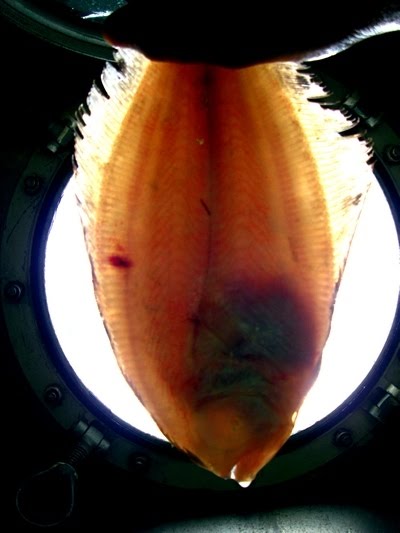
Flatfish: When you hold a flatfish up to the light you can see through it, which enables you to do an internal examination without cutting it open. On female flatfish, the gonad extends in a dark red, curved wedge which is absent in the male.


Male


Female

Personal log:

Thursday was slow for the scientists on board as the waves continued to rock the boat too much to drop our nets. The rest of the crew followed their normal duty schedule. It is hard going from night shift to day shift for meetings and then back to nights. I feel like I have spent too many hours in my bunk trying to get back on schedule. Trying to do Yoga on a ship doesn't work so well, I will be glad to get back to that when I get home.

Chef Walter did another fine job with dinner. Prime Rib and scalloped potatoes. I am usually not a prime rib person, but this was excellent. I also found where the ice cream drumsticks are stored...mmmmm.

One of the scientists I work with on night shift said, "we think of you guys as scientific volunteers first, then teachers at sea second". I will say that is the job I feel like I have been doing. The first few days I barely got my camera out b/c we were so busy. We collected a sea horse one night and I missed taking the photo before the catch was dumped. I was in the next room doing a titration and forgot to tell the rest of the shift to save it for me. :( Since then I have kept my camera close by in a drawer in the wetlab. I am learning and seeing many new things........ if anyone is a zoology teacher this is the trip for you!